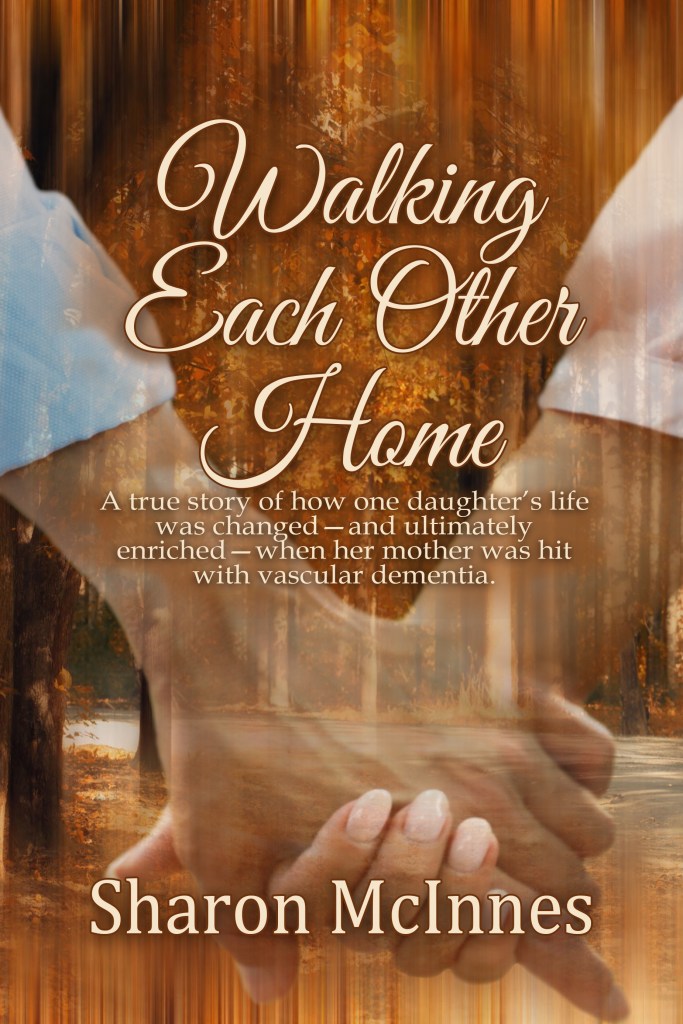
Walking Each Other Home is the story of Sharon’s caregiving journey after her mom was struck with vascular dementia. Early readers have called it “beautifully written,” “heart wrenching,” “filled with humanity, insight, and love,” and “a powerful and personal treatise.”
Available at Laughing Oyster Books in Courtenay. Or ask your local book store (anywhere in the world) to order it in.
Or buy it on Amazon here.
Or through https://books2read.com/Walking-Each-Other-Home.
Or buy a PDF for just $3.50 CDN at https://www.bookswelove.com/shop/p/walking-each-other-home.
REVIEWS
With unflinching honesty, Sharon McInnes reveals not only the grief and stress involved in caring for her mother, but also the brilliant and unexpected rewards. I’m so grateful for her depiction of the beautiful parts of caregiving — shared intimacy, deep love, laughter and silliness even in the midst of tragedy. And I’m just as grateful for her frankness about rage, despair and cleaning up poop. Walking Each Other Home is a comfort and inspiration for anyone involved in the life-changing work of caregiving. Sarah Leavitt, author of Something, Not Nothing: A Story of Grief and Love.
Sharon McInnes’ new book, Walking Each other Home, is filled with valuable information for family caregivers, as she shares the journey of caring for her mother with vascular dementia. It is also an entertaining and heart wrenching read that opens up not just the difficulties of family caregiving, but the humour and the deep and personal rewards. Jennifer Pass, Co-ordinator of Comox Valley Elders Take Action
This book is for anyone who is a caregiver, will be a caregiver, or will need a caregiver at some point (and that’s most of us). Sharon McInnes’s raw honesty paints a picture of what it is to care for someone you love, while her compassion charts a way through it. The skilled writing made this book is a page turner. I found it very hard to put the book down and when I wasn’t reading, it lingered on my mind. The mixture of humour and gravitas really worked for me. Sharon’s love for her mother, and her ability to trust her heart through all the difficult decisions that accompanied her journey of care was profound. I learned a lot – from the nitty gritty details of navigating the Canadian care system, to the importance of humour, compassion, and presence in supporting someone with dementia. I feel richer having read this and will be recommending it to anyone who will listen! Karen Selby (Amazon Review)
In Walking Each Other Home, Sharon McInnes shares her caregiving journey with remarkable honesty, compassion, and grace. Her candour about the emotional, practical, and ethical challenges of caring for a parent with dementia is both refreshing and deeply reassuring. This is not a sentimental story—it is a truthful one, filled with humanity, insight, and love. Sylvia Bourgeois, Author and Advance Reader
While the focus of this memoir is on the impact of dementia on an elderly woman in her last few years, I found it to be primarily a powerful and moving portrayal of a loving relationship between a daughter and her mother. McInnes expresses both the fears, frustration, and uncertainty of coping with her mother’s decline, as well as the moments of laughter and deep happiness which accompanied them both on their joint ‘walk home’. As our society’s awareness of the increasing incidence of dementia grows, this book offers a personal and informative guide of grace, hope, and dedication for any family challenged by this illness. Stewart Goodings, Amazon Review
Sharon’s dementia journey with her ‘mama’ documents the joys, the tears, the laughter, the struggles, and most of all the love shared between mother and daughter. So readable. So relatable for so many of us. A story full of hard realities and steep declines. I loved it! Sue Wheeler, Amazon Review
It’s hard to write about family, particularly when a family is suffering. And yet author Sharon McInnes does it exceptionally well. Add to that a brilliant grasp of dialogue. Perhaps her experience as a caregiver plays a part. Or the fact she’s a master of words, able to articulate emotions we all feel but don’t always care to acknowledge.
For these reasons I feel this book is invaluable. If you have parents, Walking Each Other Home represents the things we should know, talk about, share, and prepare for. As a career caregiver, McInnes understands the process of managing, coping, and dealing with people in need. And when the person needing that care is your parent, little else really matters.
Having recently lost my own mother, I suspect that this book felt particularly on point. But the fact remains that its content may well apply to most everyone, to some degree, at some time. I also happened to have a father who began to falter from the onset of dementia before choosing to terminate his life rather than suffer that alternate demise.
This book is a personal and yet relatable account of caring, and not merely enduring a difficult situation but in fact thriving in that demanding and challenging time. The execution and content are admirable. To reiterate, McInnes writes well, with sentient visuals, relatable phrasing, and solid, sound dialogue. The reader lives what she lives, side by side in real time. I was aware of being glad I was reading this book as I read it. Feeling, in a manner, that I’m better prepared for a future I can’t possibly know. Bill Arnott, author of A Perfect Day for a Walk
A well written, well-organized account of a daughter’s care of, and for her mother who was declining rapidly not only because of age but also dementia. The beautiful bond between daughter and mother was very evident. The narrative was intriguing (like a mystery novel) because I really wanted to see how things unfolded and were dealt with as mother’s health deteriorated. I empathized with the many hurdles that had to be faced by both mother and daughter, not only with the personal care provided but with the system. The author was very strong, determined and resourceful and an inspiration to other care providers. Jackie Snider (Amazon review)
As I read Sharon McInnes’ Walking Each Other Home, a hopeful, evocative title by the way, I couldn’t help but pace myself in that challenging journey. In many of my activities I rush along, eager to complete the task. Reading books, not so much. I like to savour them, and, typically, cumbersomely perhaps, have a few on the go at any one time. There is in Walking Each Other Home a weight, a poignancy of agonizing proportion that obliged me to move slowly. McInnes thoughtfully penetrates the love and the wounds of caring for her mother over a period of eighteen months, an exacting voyage that ends a few short months into Covid. Immersing myself in the book in portions of time added to my appreciation of her commitment, and not just hers but her partner’s as well, and other family members, to the intensity of the expedition. Often, McInnes questions her capacity to continue. She honestly understands her own needs for alone time, sanctuary. She also does not hold back on the emotional complexity of servicing/appraising the increasing needs of her mother. At one point she notes a particularly uncomfortable activity:
“One morning, I find myself in the bathroom slowly picking away, with the blunt end of a pair of tweezers, at the hard stool that’s been lodged in her bum for two days, while she grasps the edge of the counter and an unpleasant odour fills the tiny room. What the hell am I doing? The boundaries of acceptable behaviour have changed dramatically…”
At that juncture, for me, the reality of her memoir/passage could not be more impactful.
Throughout the book, Sharon McInnes takes welcome issue with the health care systems she is compelled to deal with. Though there are moments of almost agreeable bureaucratic engagement, much of her interactions with a variety of health care authorities is burdened with angst. Not just angst. Anger. Visceral anger at the systems she is forced (yes forced) to consider, their weaknesses, some simply of the human variety, others entrenched organizational ossification. As a former chair of Hornby Denman Health, a small multi-service organization that cut its teeth decades ago on the provision of localized home support to seniors (hugely modified post Covid, regrettably) I appreciated that she does not shy away from identifying the barriers she encountered to better services.
Walking Each Other Home is a powerful and personal treatise, powerful and full of lessons. Questions as well. McInnes ends with this afterword, a valuable political appeal: “It is my fervent hope that, as a society, we gain the political will to turn already-existing models of dementia care, ones that honour the individuality and dignity of our elders and support their families, from vision into reality. Surely this is not too much to ask.” Bill Engleson, Author, RSW (Retired and Non-Practicing)
Walking Each Other Home almost began as a “how-to” book, but as Sharon McInnes wrote and relived the daily joys and struggles of caring for her mother with vascular dementia over the last 18 months of her life, her motivation changed. Instead, she takes readers on her journey to show them “an unwanted, stressful caregiving journey that turned out to be a life-enhancing, soul-enriching one.”
Her story is one of gut-level honesty, grounded in love and compassion. Caregivers will immediately recognize the personal and systemic challenges she captures, and those unfamiliar with the role will come away with new awareness. The narrative is compelling and skilfully written; I found it hard to put down, even when teary-eyed. McInnes’ commitment to “quality of care” was shaped by previous experiences with long-term care facilities where seniors with dementia were sometimes medicated into compliance. That reality compelled her to search for better options. Finding none that felt right, and supported by her husband, she brought her mother into their home. The arrangement was far from simple. She wrestled with moral issues such as whether to lie or not (also known as therapeutic fabrication), and the pain that truth causes, as she watched her mother deteriorate. She admits to moments of self-doubt over her own adequacy to care, and “guilt over not foreseeing the unforeseeable.” A family therapist, she recognized the essential need for professional and peer support, rest and marriage time.
While vascular dementia is the story’s antagonist, many neuro-degenerative conditions could occupy the same role, exerting comparable pressures on caregivers. The book contains abundant practical guidance; the Afterword, aptly titled “A Message to Potential Caregivers,” offers practical insights when considering caregiving.
McInnes’ views of a system in need of reform arise from direct experience with two of British Columbia’s regional health authorities. She ends with a fervent hope that political will can be summoned to transform the province’s existing models of dementia care. Terrance James, PhD, Rehabilitation Consultant
 Sharon McInnes